
Why Your Wholesale Deal Isn’t Selling (And What Buyers Are Really Thinking)
You blasted the deal.
You sent it to your buyers list.
You posted it in Facebook groups.
You texted investors directly.
And… nothing.
Maybe a few “What’s your lowest?” messages.
Maybe silence.
Before you assume buyers are flaky, understand this:
Investors don’t pass randomly.
They pass for specific reasons.
If your wholesale deal isn’t selling, here’s what buyers are actually thinking.
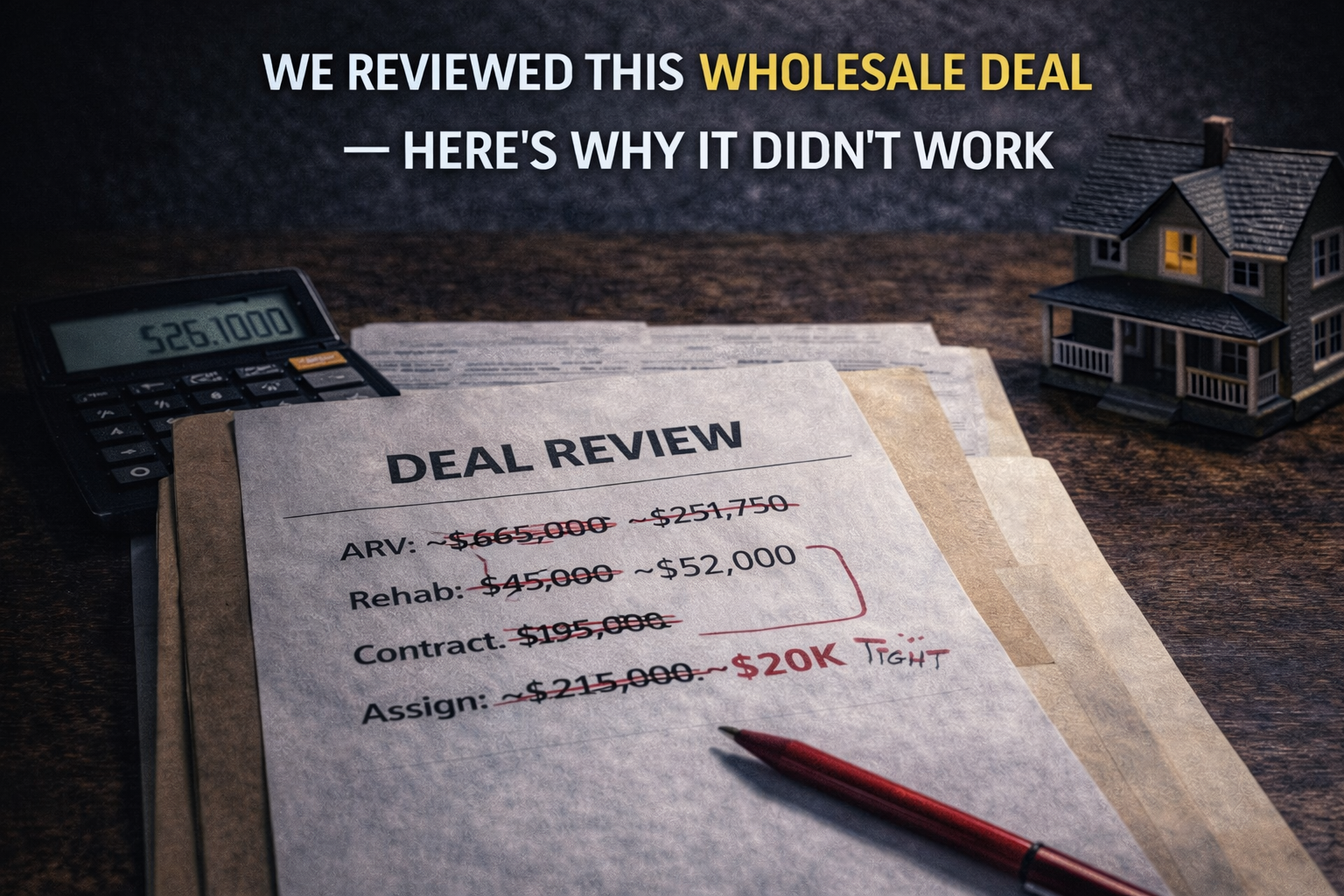
1. “The ARV Feels Stretched.”
Even if you included comps, buyers are re-running them.
They’re asking:
• Are the comps truly comparable?
• Are they recent enough?
• Were they fully renovated?
• Is the market shifting?
And just like we discussed in our previous article on
👉 How to Know If Your Wholesale Deal Is Actually Good
Buyers look at sold comps — but they also look at active listings and days on market.
If similar houses are sitting at your projected ARV, that’s a red flag.
2. “Rehab Is Probably Higher Than Advertised.”
Most wholesalers understate rehab.
Not intentionally — just optimistically.
Buyers widen numbers automatically.
If you say $40k rehab, they may be underwriting $55k.
Why?
Because they’ve been burned before.
If the deal only works at your rehab number, it won’t move.
3. “The Margin Isn’t Strong Enough.”
Here’s something wholesalers don’t see:
Buyers aren’t just calculating profit.
They’re calculating:
• Capital exposure
• Timeline risk
• Liquidity risk
• Market direction
If they’re risking $60k to make $15k, they’ll pass.
If they’re risking $60k to make $35k, they lean in.
Margin relative to risk is everything.
4. “The Assignment Fee Is Eating the Cushion.”
There’s nothing wrong with making money.
But if:
Investor profit = thin
Your assignment = heavy
The deal feels unbalanced.
That doesn’t mean your fee is wrong.
It means the structure may need adjusting.
5. “Something About This Feels Tight.”
This is the big one.
Investors develop pattern recognition.
If:
• Equity is thin
• Market is slowing
• DOM is rising
• Rehab margin is tight
• ARV feels optimistic
The deal feels fragile.
And investors protect capital first.
What Strong Deals Have in Common
Strong wholesale deals:
✔ Survive conservative ARV
✔ Survive rehab overruns
✔ Have room for assignment
✔ Work in today’s market — not last quarter’s
They don’t require perfect execution.
They have margin.
Before You Drop the Price Again
Most wholesalers respond to no traction by:
• Dropping the price
• Increasing urgency
• Blaming buyers
• Blasting again
Sometimes it’s marketing.
Sometimes it’s structure.
Sometimes it’s simply priced for a market that shifted.
Before you keep adjusting blindly, have someone underwrite it properly.
I primarily operate in Tennessee but review deals nationwide.
If the numbers make sense, I may take it down.
If they don’t, I’ll tell you why.
No hype. Just clarity.
👉 Have Justin Review Your Deal Here
Explore More Wholesale Deal Insights
Browse all articles in the Wholesale Deal Rescue section here:
👉 /category/wholesale-deal-rescue/